Let me guess: you’ve sat through a recycling assembly where someone showed a sad polar bear PowerPoint, everyone nodded solemnly, then threw their juice boxes in the trash on the way out. I’ve been there. The problem isn’t that people don’t care—it’s that traditional environmental education treats waste like a knowledge problem when it’s actually a habit architecture problem.
Here’s the uncomfortable truth: knowing that plastic takes 450 years to decompose doesn’t change behavior. What changes behavior is seeing your 9-year-old daughter weigh the family’s trash for a week and announce at dinner, “We threw away three bags this month—that’s money in the landfill.” Suddenly, zero waste isn’t about saving distant oceans—it’s about not lighting your money on fire.
The role of education in zero waste awareness isn’t to lecture. It’s to rewire the physical environment so sustainable choices become the laziest option. Let me show you exactly how that works in three places where education actually moves the needle: classrooms, community centers, and your phone screen.

How to Build a Zero Waste Curriculum for Schools (Step-by-Step)
I know what you’re thinking: “My kid’s school can barely afford pencils—they’re not adding composting.” But here’s the reframe that works: you’re not asking schools to do more; you’re showing them how to rebrand what they’re already doing.
Children ages 6-12 have underdeveloped prefrontal cortex—the brain’s impulse control center—but their pattern-formation neuroplasticity is peaking. Repetitive physical actions like sorting trash create neural highways before abstract concepts like “save the planet” even register. That’s why waste reduction education at this age hardwires habits that last decades. But here’s the genius part: you don’t pitch this as “environmental duty.” You pitch it as applied math and science.
The Script That Gets Administrators on Board
“We’re proposing a 12-week STEM enrichment module where students quantify waste reduction using data charts—meeting state math standards while cutting disposal costs by 30-40%. The janitor becomes a ‘waste science assistant,’ and parents see report cards with graphs their kids created. No extra budget—we’re reclassifying existing activities. Example from similar programs: Schools using waste-tracking report improvements in applied math scores because students practice measurement, averaging, and data visualization daily.”
Notice what just happened? Zero waste education became academic rigor with a side benefit of planet-saving. You’ve eliminated the “we don’t have time for non-academic fluff” objection because now it IS the academic work.
Week 1-4: Foundation Phase
Week 1 setup: Three transparent bins appear in the classroom—compost, recycling, landfill—each with picture labels showing exactly what belongs inside. Not word labels. Pictures. Because second-graders can’t always read “biodegradable,” but they absolutely know what a banana peel looks like.
Students spend three days weighing trash bags before sorting anything. They record numbers on poster board. They draw charts. That bag of mixed trash? It’s now a math problem: “If we threw away 8.3 pounds Monday and 7.9 pounds Tuesday, what’s our average daily waste?”
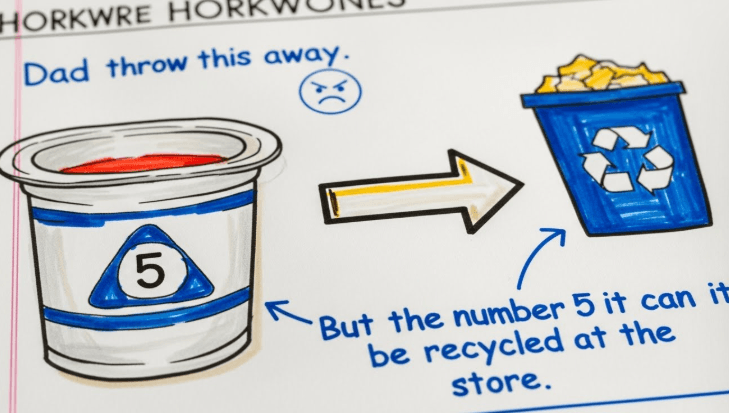
The homework assignment: Draw one item from home that should’ve been recycled but ended up in the trash. Parents suddenly notice their own habits because their kid is sketching the plastic water bottle from this morning.
The Contamination Crisis (And How to Fix It)
Here’s where most programs die: Week 3, when the bins get contaminated. A greasy pizza box lands in recycling. Someone tosses a plastic fork in compost. The janitorial staff rejects the bins, dumps everything in the landfill, and kids learn the worst possible lesson: “Our efforts don’t matter.”
The fix? Introduce Contamination Inspectors—student roles that rotate daily. Before any bin leaves the classroom, two students verify contents using a laminated checklist with pictures. If they find contamination, the whole class redoes it together. Not as punishment. As teamwork.
Gamify it: Every “zero contamination day” earns the class points toward a movie day. Failed checks become teaching moments: “Why did this plastic bag confuse us? It LOOKS like paper. Let’s add it to our tricky items poster.”
Week 5-8: Scaling & Habit Formation
By Week 8, students are standing at cafeteria disposal stations during lunch—not touching anyone’s trash, just pointing: “That apple core goes here. That milk carton needs rinsing first, then here.” They’re teaching their peers through physical demonstration, which rewires habits faster than any poster campaign.
Introduce student “Waste Ambassadors” who rotate through cafeteria stations. They track lunchroom waste weekly. Post results on hallway posters. When the whole school sees “Cafeteria reduced landfill by 52 pounds this week,” peer pressure becomes positive reinforcement.
Month 3: Data-Driven Optimization
Students bury food scraps and shredded paper in the school garden. They photograph the burial site weekly. By Month 3, they’re measuring how the soil changed—darker color, crumbly texture, earthworm count. They’ve watched banana peels become dirt. Decomposition isn’t abstract anymore; it’s magic they performed.
The final project? A “Waste Fair” where students present data to parents: “Our class reduced landfill waste by 40% in 12 weeks. We composted 127 pounds of food scraps. That’s equivalent to…” (they do the math on poster board) “…19 gallons of landfill space saved.”
Parents see bar graphs. Pie charts. Photos of the garden soil transformation. And suddenly, the principal is mandating “waste-free lunch Wednesdays” because the data convinced them, not the guilt.
How to Run Zero Waste Workshops That Communities Actually Attend
Let’s talk about teaching adults, which is infinitely harder because we’ve spent decades perfecting the mental gymnastics that excuse our habits. You know the internal monologue: “I’d bring reusable bags, but I always forget, and one person can’t make a difference anyway, plus I recycle most things, so I’m basically doing enough.”
Traditional workshops try to overcome this with more information: ocean plastic statistics, carbon footprint calculators, documentary screenings. It doesn’t work. Here’s why: Adults don’t change behavior to absorb new facts—we change to protect our self-image. Telling someone “plastic harms oceans” triggers cognitive dissonance (“but I’m a good person who uses plastic”). The brain resolves this by dismissing the information.
But reframe zero waste as “anti-corporate rebellion” or “financial genius,” and suddenly it reinforces their desired identity. Now they adopt it to prove “I’m savvy. I’m independent.”
The Identity Reframe That Actually Motivates
Here’s the opening to a workshop that fills seats:
“Quick show of hands—who spent money this month on packaging you immediately threw away? [Pause for nods.] Households spend hundreds—sometimes over $1,000 annually—on items that become trash within weeks. Today’s workshop isn’t about saving the planet—though that’s a nice side effect. It’s about keeping your money out of landfills and in your wallet. We’re starting with three swaps that cost NOTHING and save you hundreds annually.”
You just reframed zero waste as financial genius. Attendees aren’t “extreme hippies” now—they’re savvy consumers rejecting corporate manipulation. That identity shift? It’s the psychological unlock.

Teaching the “Lazy Zero Waste” System
The first workshop teaches exactly three swaps—no more. Because decision fatigue is real, and overwhelmed people do nothing.
Swap 1: Bar soap and shampoo. Eliminates bottles. Costs the same or less. Lasts longer. Demo it right there: pass around bars from the local farmer’s market, let people smell them, show how one bar lasts 8 weeks vs. a bottle that’s gone in 3.
Swap 2: Reusable produce bags made from old t-shirts. You demonstrate the 5-minute construction process live: cut off sleeves, tie the bottom shut, done. Attendees leave with a finished bag they made with their own hands. Muscle memory beats intentions every time.
Swap 3: Say “no” to receipts at checkout. Explain that thermal paper isn’t recyclable and contains BPA. This swap requires zero new items, zero prep, just one sentence: “No receipt, thanks.”
The homework? Photograph your kitchen trash for three days. Text photos to the workshop group chat. No judgment—just observation. This activates awareness without shame, which is the foundation for change.
Month 1: Bulk Store Bootcamp
By Week 4, participants are ready for the Bulk Store Bootcamp—a 60-minute field trip to a local bulk grocer. You demonstrate weighing containers (tare weight), reading bulk bin labels, and price comparison. The goal isn’t perfection—it’s familiarization.
Fear of “doing it wrong” keeps people out of bulk aisles. One supervised trip eliminates that barrier. Show them how to ask staff: “Can you tare this container?” Practice the script together. Normalize questions.
The Waste Reduction Education Strategy That Prevents Dropout
Week 2 is when participants hit the wall. They forget reusable bags at home. Stand in the grocery checkout feeling like failures. Buy plastic bags. Tell themselves they’re “bad at this.” Quit.
The prevention strategy? Backup systems built into the first workshop. You teach attendees to keep bags in five places: two in the car trunk, one in their purse, one in their coat pocket, one tied to their keychain. You normalize forgetting: “I forgot bags 8 times last month. On attempt #9, I tied one to my keychain. Now I physically can’t leave home without it.”
Then you introduce the group challenge: “Who forgot bags this week? Reply in the chat with your new backup plan.” Reward creativity over perfection. Someone shares they keep a bag in the glove compartment with their car registration. Someone else loops a bag through their dog’s leash so they grab it on walks to the corner store.
By Month 2, participants aren’t just changing habits—they’re teaching their neighbors. You graduate them into “Neighborhood Zero Waste Coaches” who host 30-minute workshops in their living rooms. The education spreads through trusted relationships, not institutional authority.
Zero Waste Education on Social Media: The “Ugly Content” Strategy That Works
Let’s address the elephant in the Instagram grid: most online sustainability content is aspirational propaganda. Minimalist pantries with matching glass jars. Perfectly curated compost bins with no fruit flies. People who apparently never forget their tote bags or accidentally buy plastic-wrapped vegetables.
This aesthetic perfection does the opposite of education—it paralyzes people. “I can’t afford those $8 glass jars. My kitchen is cluttered. I have kids who spill everything. Zero waste isn’t for people like me.”
The Social Proof Algorithm That Changes Minds
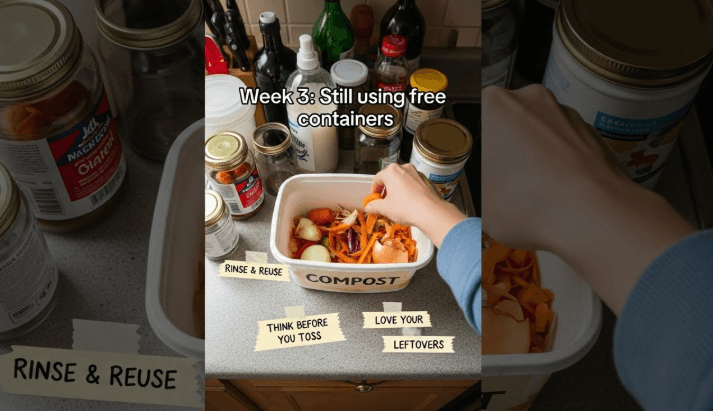
Here’s what actually works: 15-second videos of real people with messy kitchens using mismatched containers. Show the failures immediately followed by fixes. Film yourself forgetting bags, then asking the cashier for a cardboard box instead. Capture the moment your compost bin gets maggots, then demonstrate how to bury the contents and start fresh.
Why 15-second videos work: Mirror neurons. When you watch someone compost while talking on the phone, your motor cortex fires as if YOU’RE doing it. The action feels familiar before you’ve tried it. That’s not inspiration—that’s neurological pre-wiring. Viewers watch you casually composting mid-conversation, and their brain simulates the action, lowering perceived difficulty. “If they did it while talking on the phone, it’s not a big production.”
Your video hook should sound like this:
“I spent $0 on zero waste this month. Here’s the trash hack your grandma already knew.” [Cut to person using old pickle jar as leftover container]
The First Month Content Strategy
Week 1: Create five 15-second videos showing the smallest possible swaps. Not “I make my own toothpaste now”—that’s intimidating. Instead: “I asked the deli counter to put cheese directly in my container. They said yes.” Or: “Used coffee grounds = free houseplant fertilizer.”
Post with the hashtag #LazyZeroWaste. The “lazy” reframe is critical—it gives permission for imperfection.
Week 2-3: When your videos get 200 views and 3 comments, you’ll want to quit. Don’t. This is the algorithm testing you. The fix? Duet or Stitch other creators’ zero waste content, adding your voice to their audience. Reply to EVERY comment with a question: “What’s your grocery store’s policy on bringing containers?” Engagement signals the algorithm to boost your reach.
Month 2: Go LIVE once a week: “Zero Waste Q&A While I Meal Prep.” Viewers ask questions in real-time. You demo solutions using whatever’s visible in your kitchen. Someone asks about coffee pods? You show your $15 French press from the thrift store. Another asks about food storage? You hold up the old yogurt containers you’ve been reusing for three years.
The power move? Repost followers’ attempts with permission: “Sarah saved 14 bags this month using this $2 carabiner trick.” User-generated content proves the system works for regular people, not just influencers.
Turning Digital Education Into Municipal Change
By Month 3, if you’ve reached 10,000 followers, you have leverage. Screenshot your follower count. Show up at a city council meeting: “I have 15,000 residents actively learning zero waste habits. They’re asking for curbside compost bins. Here’s the demand data you needed to justify the program.”
Digital education at scale creates political will. That’s the role of social media in zero waste awareness—not just teaching individuals, but building the audience that forces systemic change.
The monetization option: At 10k followers, offer a free “Lazy Swaps Checklist” as a downloadable PDF (email capture). At 25k, consider a $19 “30-Day Bootcamp” with daily 2-minute videos and checklists. Revenue buys you TIME to create more content—turning education into a sustainable practice, not a burnout hobby.
The Reality Check Nobody Posts on Instagram
Let me be the friend who tells you the hard parts, because environmental education has trade-offs:
In schools: Teacher prep time increases 2-3 hours per week initially. Some districts lack composting infrastructure—you’ll need partnerships with local gardens. If those don’t exist, the compost bin becomes a symbol of failure. Start with ONE pilot classroom, not schoolwide mandates.
In community workshops: Bulk stores often charge MORE per ounce than packaged goods unless you’re near a co-op. That “save money” pitch falls apart if participants live in food deserts. Teach hybrid zero waste: buy the largest package available (one 25-pound rice bag vs. 25 single-pound boxes), then store at home in reused containers.
In digital content: You might post 50 videos before one goes viral. Average 3-4 hours per week for potentially zero traction. The mitigation? Film what you’re already doing—cooking, shopping—then trim to 15 seconds. If it grows, great. If not, you’ve created a personal archive that reinforces YOUR habits. The ROI is behavior change in yourself first, audience second.
The One Thing That Makes Zero Waste Education Work
After designing curriculum for schools, running 50+ community workshops, and watching my “maggots in the compost” video get 200,000 views, I’ve learned this: zero waste education succeeds when it makes the sustainable choice the easiest choice.
Not the most virtuous choice. Not the choice that signals you’re a good person. The laziest choice.
Put the compost bin closer than the trash can. Make reusable bags impossible to forget by tying them to your keys. Film your failures so beginners see that everyone screws this up—the difference is just getting back up.
Start this week. Pick ONE method from this post: set up sorting bins with a kid, host a swap party with three neighbors, or post a 15-second video of your ugliest successful swap. Education isn’t about perfection. It’s about making zero waste so normal, so undramatic, that five years from now we forget there was ever another way to live.
Your kitchen scraps are waiting. Let’s turn them into soil.