You’ve been washing jars, carrying reusable bags, and composting for months. But when you look around your neighborhood, you see overflowing trash bins and that sinking feeling you’re the only one who cares.
Here’s what nobody tells you: Individual zero waste efforts burn you out because you’re fighting systems designed for convenience. That social awkwardness when you’re the only person with cloth napkins? That’s not failure—that’s a sign you need infrastructure, not more willpower.
Community initiatives promoting zero waste don’t just multiply impact. They divide the emotional labor and create local systems where sustainability becomes the default. You need what humans have always needed: other people solving the same problems.

What Makes Community Zero Waste Programs Successful (5 Key Elements)
After watching dozens of sustainability efforts launch with fanfare and die within three months, I’ve noticed something: the ones that survive don’t start with perfection—they start with systems that prevent burnout.
Successful community initiatives promoting zero waste share these characteristics:
- Hyper-local focus: They solve problems specific to your neighborhood (contaminated recycling, no bulk stores, 20-mile drive to textile drop-off)
- Rotating leadership: No single “sustainability coordinator” who burns out by month four
- Built-in quality filters: Standards that prevent the program from becoming a dumping ground
- 72-hour maximum commitment: No initiative requires more than 3 hours per person per month
- Visible infrastructure: Physical markers (decorated bins, laminated signs, painted boxes) that work even when enthusiasm fades
These aren’t abstract principles. Let me show you the exact systems.
How to Start a Zero Waste Community Group (Week 1 Action Plan)
You don’t need a formal organization. You need one other person who’s also tired of being the weird eco-warrior.
Start here:
- Check local Facebook groups, Nextdoor, or community bulletin boards for existing sustainability groups
- Visit your library, farmers market, or community center—these spaces attract like-minded people
- Search for “Buy Nothing” groups (these sharing economy networks are goldmines)
- Look for tool libraries, repair cafes, or community gardens—people there already live this way
“Hey, I noticed you bring reusable bags too. I’ve been trying to reduce waste but it feels isolating. Would you be interested in grabbing coffee to talk about starting something in the neighborhood? Even just sharing tips would help.”
This works because it acknowledges the isolation, proposes low-commitment connection, and frames it as mutual benefit.
Week 1 deliverable: One coffee conversation. That’s it.

Week 2-3: Map Your Community’s Specific Waste Problems
Before launching community zero waste initiatives, understand where waste happens in your specific area. This isn’t about judgment—it’s about identifying pain points where people genuinely want solutions.
Conduct a 90-minute waste audit walk:
- Walk your neighborhood on trash day—note patterns (contaminated recycling? Piles of Amazon boxes? Food waste in trash bags?)
- Visit three local businesses—ask what they struggle to recycle
- Check if your area has accessible composting, hazardous waste collection, or textile recycling
- Identify “waste deserts” (areas with zero sustainable disposal options within 2 miles)
You’re looking for systemic gaps, not individual failures. One community I worked with discovered their biggest waste source was single-use party supplies from frequent neighborhood gatherings. They launched a party supply library. Within six months, events generated 80% less waste.
Week 2-3 deliverable: A list of three specific problems (not “too much waste”—problems like “no bulk food store within 10 miles” or “apartment dwellers can’t compost”).
How to Launch a Neighborhood Item Swap Network (Without the Hoarding Problem)
Swap networks sound simple until Week 2, when someone dumps broken junk and takes everything valuable. Here’s the system that prevents that.
The Psychology: People hoard items “just in case” because they fear future scarcity. Swap networks only work when participants trust the supply will regenerate.
The Magic Script (Week 1 Kickoff):
“We’re testing a closed-loop system where 15 households become their own supply chain. You’re not giving stuff away—you’re putting it in a shared inventory you can access anytime. We start with ONE category: kids’ clothes, sizes 2T-6T. Bring clean, unstained items in a labeled bag. Take whatever fits your kid. This only works if we all maintain quality standards.”
Notice what this does: Creates artificial scarcity (15 households, one category), establishes quality expectations upfront, and frames it as mutual infrastructure, not charity.
Week 2 Trap (Expect This): Someone will bring stained clothes or broken toys. This is your quality filter test.
The Fix: Create a laminated “Swap Standards” card:
- Clean enough you’d give it to a friend
- Functional (no missing buttons, broken zippers)
- Current season appropriate
Post it visibly. Return items that don’t meet standards with a kind note: “These don’t meet our swap standards—try the free box at [location] instead.”
Preventing Burnout: Rotate “seasonal swap captains” every 3 months. The captain coordinates the event, checks quality, and organizes leftover donations. After their term, they get a handwritten thank-you card from the group. Gratitude rituals prevent resentment.

How to Start a Bulk Buying Cooperative (Without Coordination Hell)
Bulk buying co-ops fail because coordination fatigue kills them by month three. Someone has to track orders, collect money, receive shipments, sort portions, and notify everyone. That person burns out.
The Psychology: People underestimate coordination labor. They think “group orders” mean “split shipping costs.” They don’t realize someone is doing unpaid supply chain management.
The Magic Script (Prevent This Trap):
“This isn’t a shopping club—it’s infrastructure. We’re building a system where four people rotate monthly as ‘Order Captain.’ Your month requires 2 hours of work: collecting the pre-committed order list, placing the bulk order, receiving delivery, and texting pickup times. If you can’t do your assigned month, you find your replacement. We’re creating a supply chain, not asking someone to volunteer forever.”
This works because it names the labor, quantifies the time commitment, and distributes responsibility before enthusiasm fades.
Week 1 System Setup:
- Identify 8-12 households (minimum viable co-op size)
- Choose ONE bulk supplier (Azure Standard, Thrive Market, local restaurant supplier)
- Create pre-committed rotation: Assign Order Captain months for 6 months in advance
- Establish the “72-hour rule”: Orders must be picked up within 72 hours or forfeit to the next person
Week 2 Trap (Expect This): Nobody has enough storage containers. People show up with random Tupperware and Ziploc bags.
The Fix: Launch a “Container Library.” Each household contributes $40 to buy 50 uniform glass jars and 20 mesh produce bags. These belong to the co-op, not individuals. You borrow them, fill them, return them at next month’s pickup. It’s the only way to prevent the bag/jar problem from killing your program.
Reality Check: Calculate your time-value trade-off. If sorting and pickup take 2 hours and you save $30, you’re earning $15/hour. If your time is worth more than $25/hour, bulk co-ops may not be your best zero waste initiative. That’s fine—do swap networks instead.
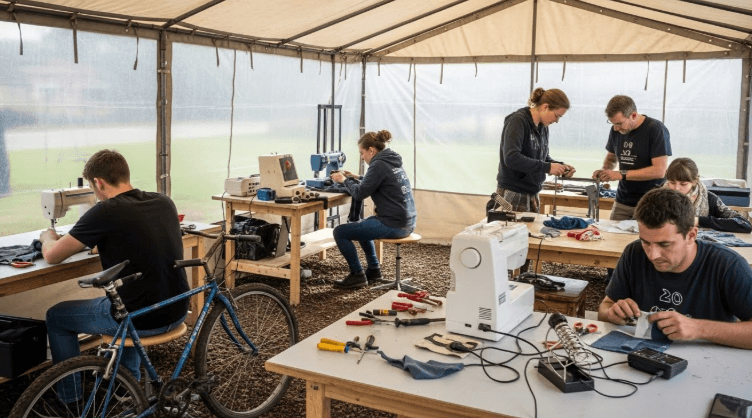
How to Launch a Repair Café (Without Becoming Free Tech Support Forever)
Repair cafés die when the one person who can fix things becomes the neighborhood’s unpaid repair service. Here’s the system that prevents that.
The Psychology: People want to learn repair skills, but they’re intimidated. They also secretly hope someone will just fix it for them. Your job is to shift the frame from “fix my thing” to “learn with me.”
The Magic Script (Posted on Every Event Invite):
“Bring something broken and a notepad. While Maria diagnoses your lamp, you’ll write down what’s wrong and what tools you’d need to fix it. If it’s fixable in 15 minutes, we’ll do it together. If not, you’ll leave with a repair plan and resources. Success = understanding your object, not walking out with a fixed item.”
This reframes the event from “free repair service” to “diagnostic education.”
The 15-Minute Rule: Each item gets 15 minutes maximum. This prevents one complicated repair from consuming the whole event and burning out your skilled volunteers. Set a timer. When it buzzes, move to diagnosis and education mode.
Week 3 Reality Check (Tell People This Upfront): 70% of items will be unfixable—either parts are unavailable, repair costs more than replacement, or it’s designed to be unrepairable. That’s not failure. Success is shifting future purchasing decisions. “Now I know to avoid brands that use proprietary screws.”

How to Promote Community Zero Waste Programs (Without Sounding Preachy)
Most community sustainability efforts die because the communication feels like a guilt trip. People don’t join communities to be lectured. They join to feel connected, helpful, and part of something positive.
Frame invitations around benefits, not obligations:
“We’re starting a neighborhood swap meet the third Saturday of each month. Bring clothes your kids have outgrown, books you’ve finished, or kitchen gadgets collecting dust. Leave with ‘new’ stuff and meet your neighbors. Coffee and pastries provided. No pressure to bring or take anything—just come hang out!”
Notice what this includes:
- Specific logistics (when, what to bring)
- Multiple entry points (bring stuff, take stuff, or just socialize)
- Social incentives (meet neighbors, free food)
- Explicit permission to participate imperfectly
It doesn’t mention “waste reduction” or “sustainability.” Let people arrive at zero waste through doors that matter to them—saving money, decluttering, meeting people, finding kids’ clothes. Your motivations don’t have to be their motivations.
Month 2: Building Momentum Without Burning Out the Organizer
Around month two, people start bringing you ideas. “Could we add a tool library?” “What about bulk food orders?” Suddenly you’re the unofficial sustainability coordinator, and you didn’t sign up for a second job.
Protect your energy by distributing ownership:
- Let others champion new initiatives—you don’t manage everything
- Create a shared doc where people sign up to lead specific efforts
- Establish that initiatives survive based on champion availability, not group obligation (if the champion moves, the program pauses or ends)
- Rotate coordination duties so no one becomes indispensable
- Build in breaks—monthly events can pause for holidays without failure
“I love that idea! Would you be willing to organize the first one? I’m at capacity with the composting hub. Here’s what worked well when we launched that—feel free to adapt whatever’s useful.”
This celebrates the idea, offers support without overcommitting, and empowers them to lead. Successful community zero waste movements have many leaders, not one exhausted martyr.
Partnering With Local Businesses for Mutual Benefit
Individual efforts are powerful, but partnerships multiply impact. Local businesses, libraries, schools, and faith communities already have infrastructure you can leverage.
Approach partnerships with mutual benefit:
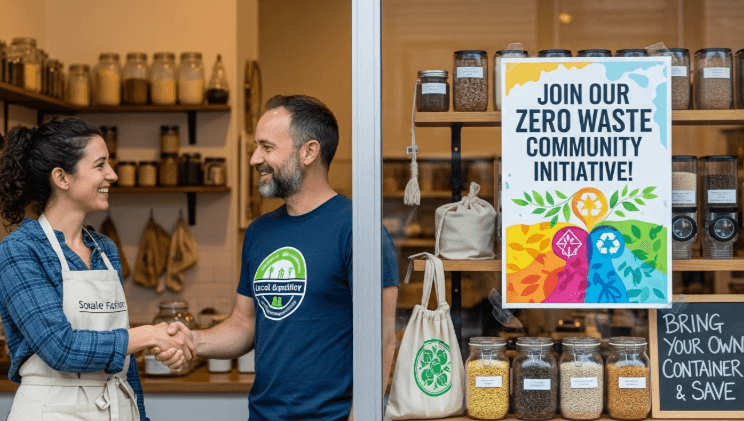
- Local businesses: Offer to promote their bulk items in exchange for space to host swap meets
- Libraries: Propose hosting repair cafés—they love community programming and have tables
- Schools: Student service hours = free labor for sorting swap items or maintaining composting hubs
- Faith communities: Underutilized space and existing community service frameworks
- Buy Nothing groups: Natural allies for sharing economy initiatives
One community initiative partnered with a coffee shop struggling with food waste. The shop lets the composting hub collect coffee grounds and pastry scraps, promotes the hub on their chalkboard, and hub members frequent the shop. Everyone wins.
Solving Common Problems in Community Zero Waste Programs
Let’s talk about what nobody mentions: the conflicts.
Someone will contaminate the compost with plastic. Another person will take everything at the swap without bringing anything. A neighbor will complain about foot traffic. Someone will criticize you as “not zero waste enough.”
These conflicts don’t mean failure. They mean your initiative is real.
Address issues with clear, kind boundaries:
- Create simple, visible guidelines (laminated signs at composting hubs, one-page swap rules)
- Assume good intentions first—most problems are confusion, not malice
- Address patterns privately, not individual incidents publicly
- Adjust systems based on recurring problems rather than trying to change people
When someone criticized a free box for “encouraging consumerism,” the organizers didn’t debate philosophy. They added a sign: “Take what you’ll use this month, leave treasures for others.” Problem solved.
How to Track Zero Waste Community Impact (Beyond Weight Metrics)
Yes, track pounds diverted—they’re satisfying and useful for grant applications. But the real markers of successful community initiatives promoting zero waste are harder to quantify:
- Neighbors who didn’t know each other now coordinate carpools
- Someone fixed their toaster at repair café instead of buying new
- A family trying to reduce waste now has friends doing the same
- Local businesses ask how they can participate
- New residents seek out your group specifically
- Sustainable behaviors become neighborhood norms, not individual quirks
The goal isn’t perfect zero waste—it’s creating a community where sustainable living feels easier than unsustainable living. Where borrowing your neighbor’s ladder is simpler than buying one. Where composting happens because there’s a hub three houses down. Where reducing waste is shared infrastructure, not a solo burden.
Start With One System, Not Perfect Vision
You don’t need a non-profit, a grant, or a committee. You need to start one specific system with one other person.
Choose based on your Week 2 waste audit:
- No bulk store nearby? Launch the buying co-op.
- Lots of families with kids? Start the clothing swap.
- Apartment building with no composting? Create the shared hub.
- Community of tinkerers? Launch the repair café.
Community zero waste initiatives succeed not because they’re perfectly executed, but because they solve real problems. Your neighbors are also overwhelmed by packaging, frustrated by planned obsolescence, and craving connection. You’re not imposing values—you’re building infrastructure for values people already hold but can’t act on alone.
So find that one person. Map your specific challenges. Launch one system with built-in burnout protection. Rotate leadership. Track small wins. And watch what happens when sustainability stops being a solo project and becomes neighborhood infrastructure.
The planet needs system change. System change starts with the systems we create together in our own communities. Start there. Start now. Start with one.